A Project '44 Case Study

L/Cpl George Pollard

Lance Corporal Stormont, Dundas and Glengarry Highlanders · 9th Cdn Infantry Brigade · 3rd Cdn Infantry Division Born 28 May 1923, Cornwall, Ontario · Killed 17 June 1944, Abbaye d'Ardenne, Normandy

By Project '44 Team 8 min read

Seventeen years old and lying about his age, George Pollard enlisted against his mother's wishes in June 1940. Four years later, he landed at Bernières-sur-Mer on D-Day. On the night of 16 June 1944, he went out on a patrol near Vieux Cairon that ran into three trip wires. Wounded and taken prisoner, he was brought to the Abbaye d'Ardenne on the orders of Kurt Meyer — and never seen again. His body has never been found.

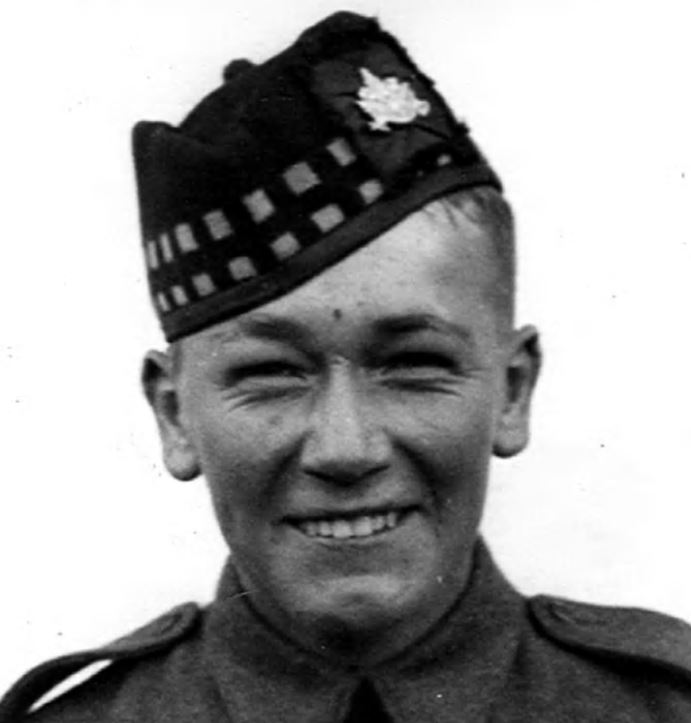
L/Cpl George Pollard — Stormont, Dundas and Glengarry Highlanders.
I

Cornwall

1923–1940
George Pollard was born on May 28, 1923, in Cornwall, Ontario. He first tried to enlist with his local militia, the Stormont, Dundas and Glengarry Highlanders, in September 1939 — and was turned away for being underage. He tried again on June 27, 1940, lied about his age, and was accepted. His mother Ethel did not approve. George told her that if she said anything, he would run away and enlist somewhere else.
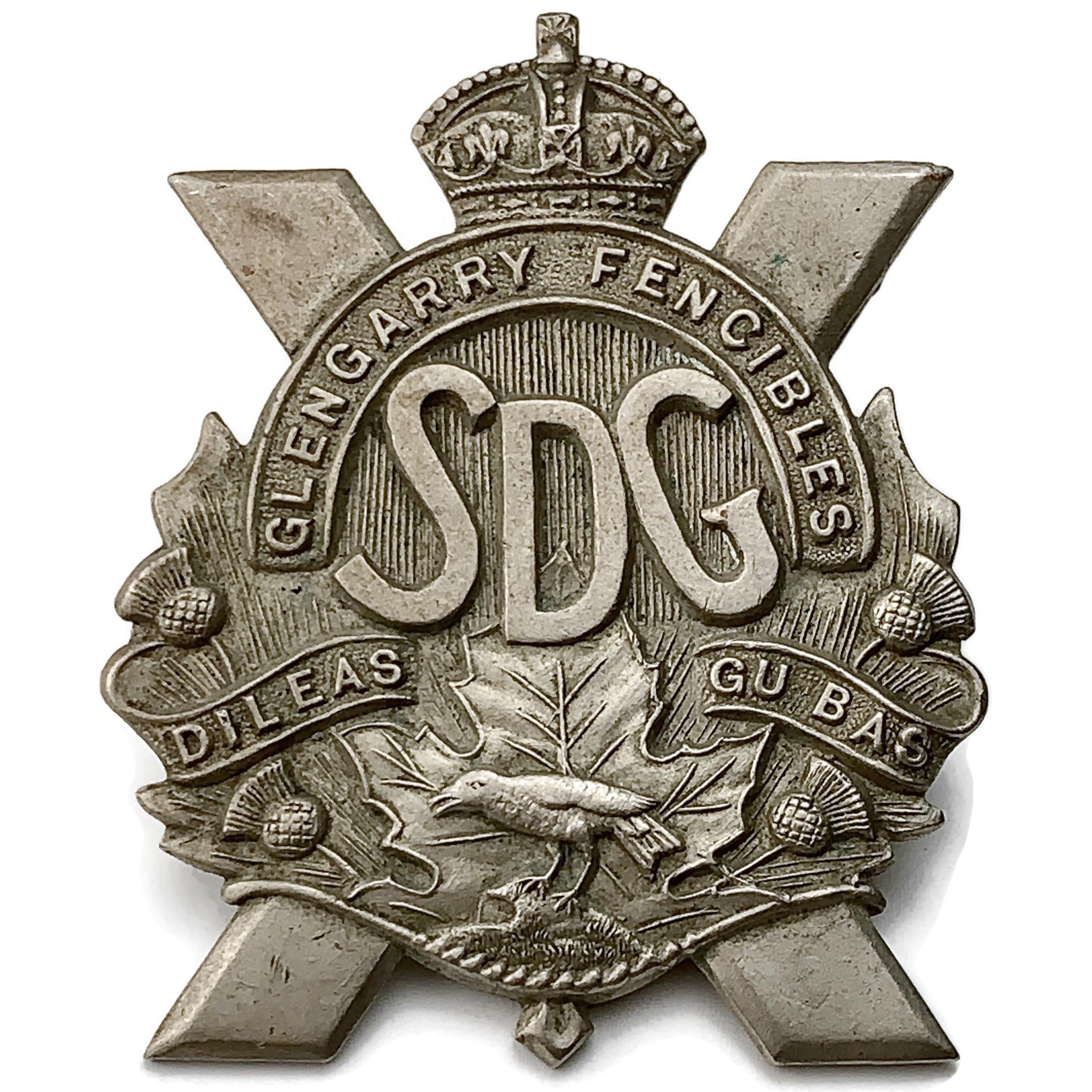
Cap badge of the Stormont, Dundas and Glengarry Highlanders — "the Glens" — raised in Cornwall, Ontario in 1868.
The Glens — originally raised in Cornwall in 1868 — sailed for Great Britain in July 1941 as part of the 3rd Canadian Infantry Division. George and his fellow soldiers would spend the next three years in England, training for an invasion they knew was coming but couldn't name. By 1944 they knew: they would land on D-Day with the 9th Canadian Infantry Brigade, in reserve behind the 7th and 8th Brigades.
II

Bernières-sur-Mer

6 June 1944
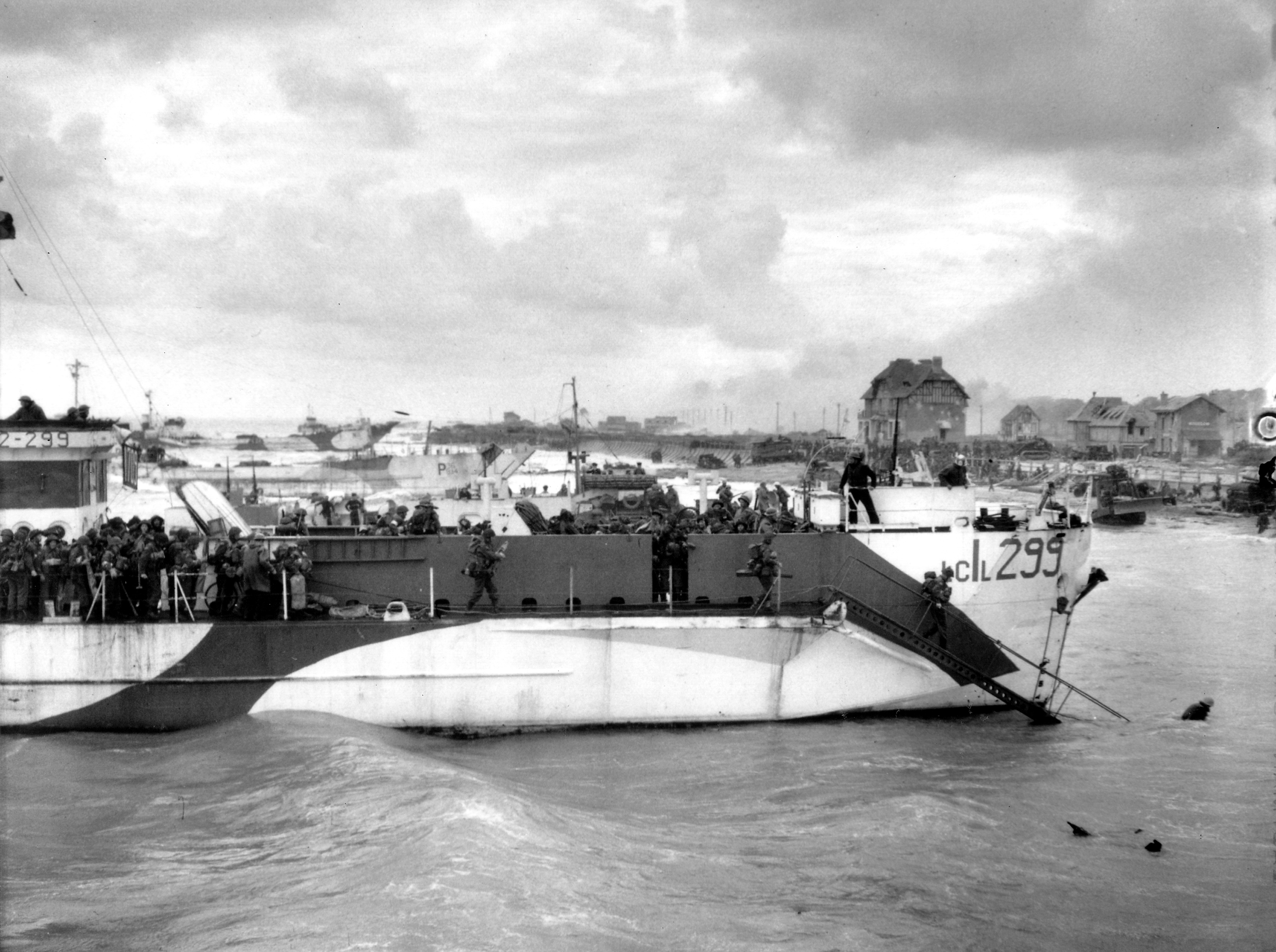
Infantry from the Stormont, Dundas and Glengarry Highlanders unloading from LCI 299 (Landing Craft Infantry)
At 0900 hours on June 6, 1944, the ship carrying the SDG's received the code word "Katnip." They landed at Bernières-sur-Mer on White Beach. By evening they were in Bény-sur-Mer, taking their first casualties from German mortar fire.
III

Vieux Cairon

16 June 1944
Eleven days later, the battalion was dug in at Vieux Cairon, holding a compromised position at the bottom of a long sloping valley. The German 12th SS Panzer Division held the high ground at Gruchy and Buron. Patrols moved out each night. At 1700 hours on June 16, 1944, Lt. Williams returned from his brigade briefing with orders. A mixed patrol — sixteen SDG infantry and seven sappers from the Royal Canadian Engineers, twenty-three men total — would move up toward Gruchy in darkness and destroy German tanks with explosives. George Pollard was among them.
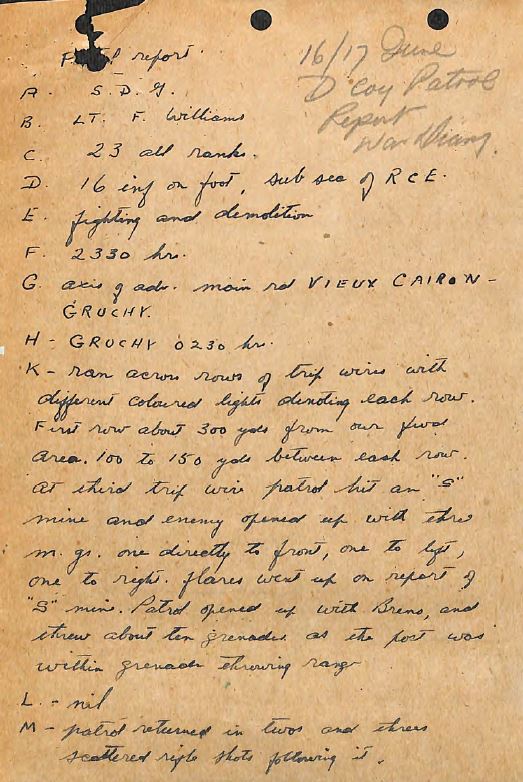
Patrol report from the SD&G war diaries that was the hidden clue to George Pollard's Last Patrol
The patrol left at 2330 hours under a moonless sky, so dark the men tied themselves together with shoelaces to keep from losing each other in the grass. Three hundred yards from their own lines they hit a trip wire and a coloured flare arced toward the German trenches. They kept moving. A hundred and fifty yards further, a second trip wire. They kept moving. Sometime in the early hours of June 17, near the top of the rise and only a hundred yards from the German position, a soldier stepped on a third trip wire. An S-mine detonated. A flare went up. Machine guns opened fire from less than a hundred yards away. In the exchange, Lt. Williams and L/Cpl George Pollard were wounded and one sapper killed. Williams, lying in the grass, called out: *"Carry on Cpl and give them hell!"* The surviving men frantically untied themselves and fought their way back to Vieux Cairon in twos and threes. By morning, only Williams and George were unaccounted for.
IV

Abbaye d'Ardenne

17 June 1944
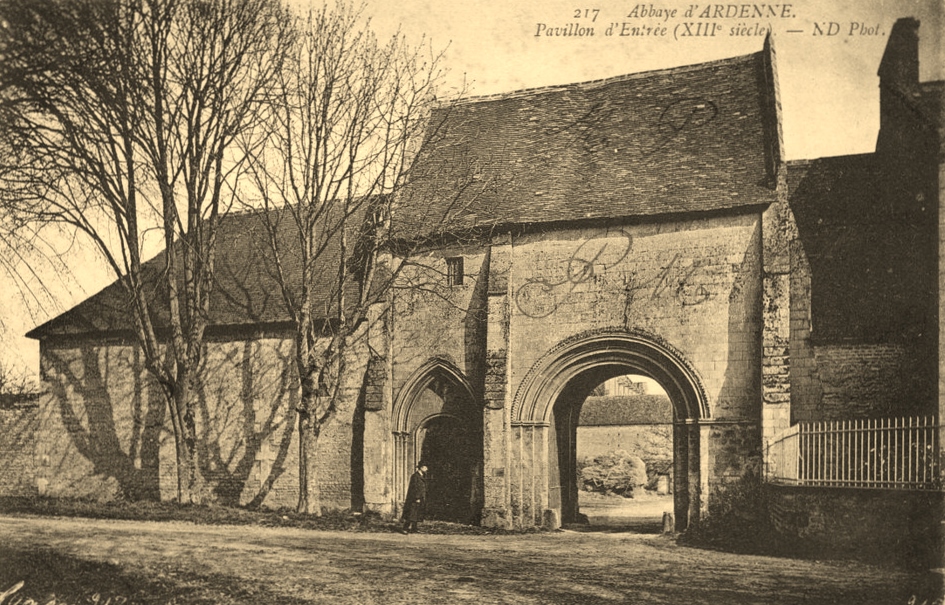
A German patrol found them wounded in the grass and carried them back across the lines to the 25th Panzer Grenadier Regiment's headquarters — and from there, to the divisional headquarters of the 12th SS Panzer Division at the Abbaye d'Ardenne, an eleventh-century monastery where SS-Standartenführer Kurt Meyer had been watching the Allied advance since D-Day.
The Abbaye d'Ardenne — divisional headquarters of the 12th SS Panzer Division, June 1944.
As prisoners of war, George Pollard and Lt. Williams were entitled under the Geneva Convention to medical care and the protection of their captors. Instead, on Meyer's orders, both men were executed in the abbey's garden courtyard. Williams's body was found two months later by French civilians returning to the site. George's body has never been found.
V

A telegram to Cornwall

June 1944 and after
On June 25, 1944, a telegram reached Ethel Pollard in Cornwall. Her son was reported Missing In Action. A second telegram followed, listing him as "presumed dead." Kurt Meyer was captured by American soldiers in September 1944 — three months after George was killed. Tried in Canada and sentenced to death, he appealed; the sentence was commuted to life imprisonment by General Vokes. He served nine years. Ethel Pollard read the trial records and slowly learned pieces of what had happened to her son. She refused to believe he was dead. She spent the rest of her life waiting for George to come through her kitchen door. His memorial rests today at the Museum of the Stormont, Dundas and Glengarry Highlanders in Cornwall, Ontario. The Pollard family still hopes, one day, for George's remains to be found.

Piecing the Story Together

For most of eighty years, what happened to L/Cpl George Pollard on the night of June 16–17, 1944, lived only in fragments — a telegram to his mother Ethel in Cornwall, testimony at Kurt Meyer's trial, a line in the war diary of the Stormont, Dundas and Glengarry Highlanders, a grief that a family never put down.

Project '44 pieced the night back together. We found the war diary entry for the patrol. We found the patrol report — the kind of document that ordinarily disappears into an archive box and is never read again — detailing the twenty-three men who went out, the three trip wires, Lt. Williams's call to "carry on Cpl and give them hell." We mapped the route the patrol took out of Vieux Cairon, up the sloping valley toward the German position, to the point where the S-mine detonated. We mapped the path back to the Abbaye d'Ardenne, where George and Lt. Williams were taken.

What our research produced is not closure. George's body has never been found, and may never be. But for the first time, his family and anyone else who cares to look can see — plotted on a modern map, drawn from primary sources — exactly where he walked on the last night of his life, and exactly where he was killed.

Credits

Researched and written by the Project '44 team.

With thanks to the Pollard family, the Museum of the Stormont, Dundas and Glengarry Highlanders in Cornwall, Ontario, and Library and Archives Canada.

Further Reading

Sources

  1. War Diary, Stormont, Dundas and Glengarry Highlanders, June 1944. Library and Archives Canada, RG 24.
  2. Patrol report, SDG Highlanders, 16–17 June 1944.
  3. Trial transcripts, R. v. Meyer (1945–46).
  4. Pollard family papers, courtesy of the Pollard family.
  5. Museum of the Stormont, Dundas and Glengarry Highlanders, Cornwall, Ontario.